

In short
The BNI® Code of Ethics has six “I will…” commitments: provide the quality you quoted for, be truthful, build goodwill and trust, follow up on the referrals you receive, display a positive and supportive attitude, and live up to the ethical standards of your profession.
The six points
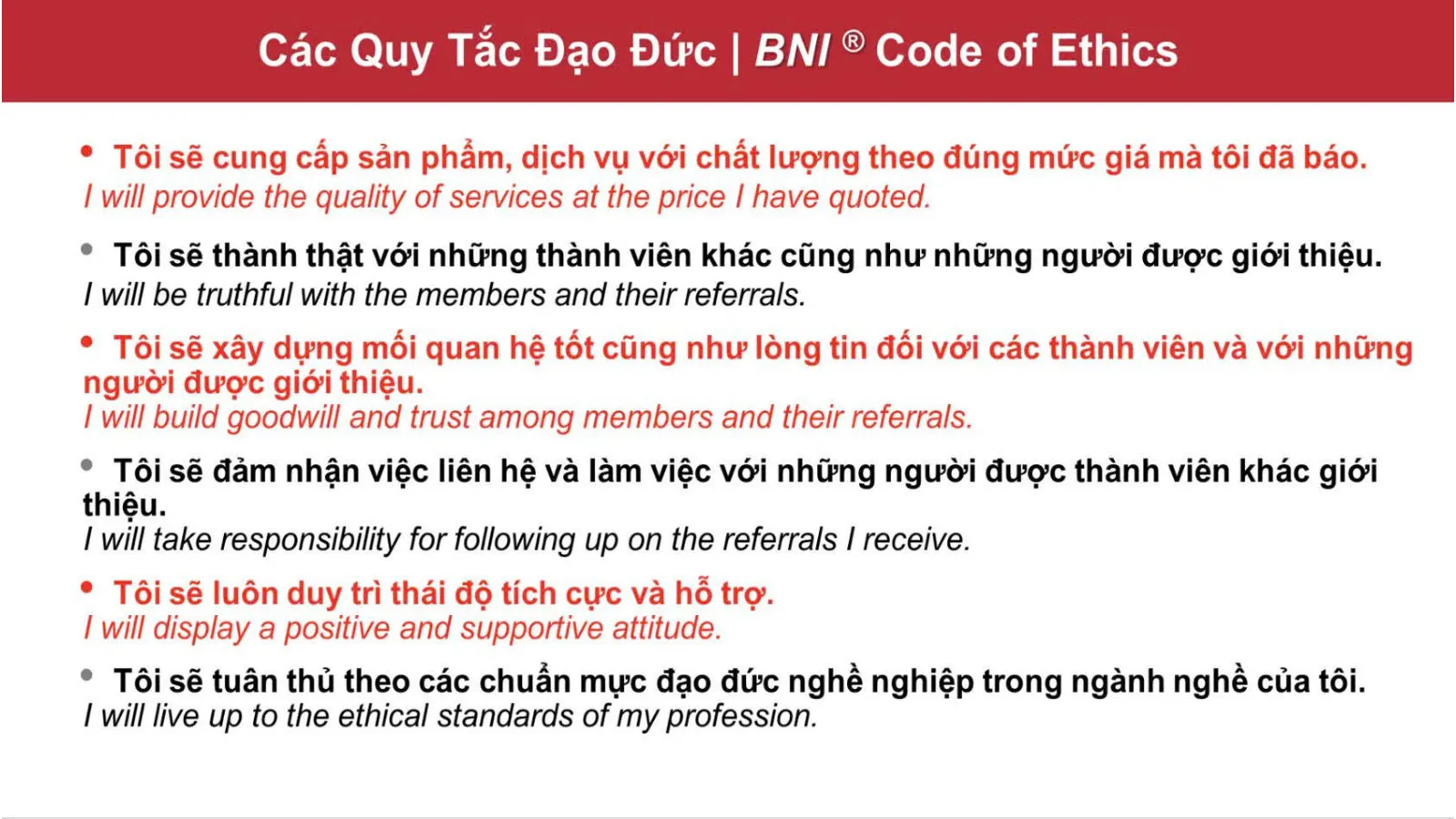
The six points of the BNI Code of Ethics, exactly as in the chapter meeting material (the italic line is the Vietnamese wording):
I will provide the quality of services at the price I have quoted.
Tôi sẽ cung cấp sản phẩm, dịch vụ với chất lượng theo đúng mức giá mà tôi đã báo.
I will be truthful with the members and their referrals.
Tôi sẽ thành thật với những thành viên khác cũng như những người được giới thiệu.
I will build goodwill and trust among members and their referrals.
Tôi sẽ xây dựng mối quan hệ tốt cũng như lòng tin đối với các thành viên và với những người được giới thiệu.
I will take responsibility for following up on the referrals I receive.
Tôi sẽ đảm nhận việc liên hệ và làm việc với những người được thành viên khác giới thiệu.
I will display a positive and supportive attitude.
Tôi sẽ luôn duy trì thái độ tích cực và hỗ trợ.
I will live up to the ethical standards of my profession.
Tôi sẽ tuân thủ theo các chuẩn mực đạo đức nghề nghiệp trong ngành nghề của tôi.
How it links to the core values
Three of the six points sit close to BNI’s core values: point 5 (a positive and supportive attitude) matches Positive attitude; point 4 (following up referrals) is close to Accountability — BNI writes “We keep the promises we make, especially when it is hard to do so” (About BNI); point 3 (goodwill and trust) is close to Building relationships. See BNI’s 7 core values.
| # | Point (short) | Closest core value |
|---|---|---|
| 1 | Quality at the price quoted | — |
| 2 | Truthful with members and referrals | — |
| 3 | Build goodwill and trust | Building relationships |
| 4 | Follow up on referrals received | Accountability |
| 5 | Positive and supportive attitude | Positive attitude |
| 6 | Ethical standards of my profession | — |
Why ethics is a matter of reputation
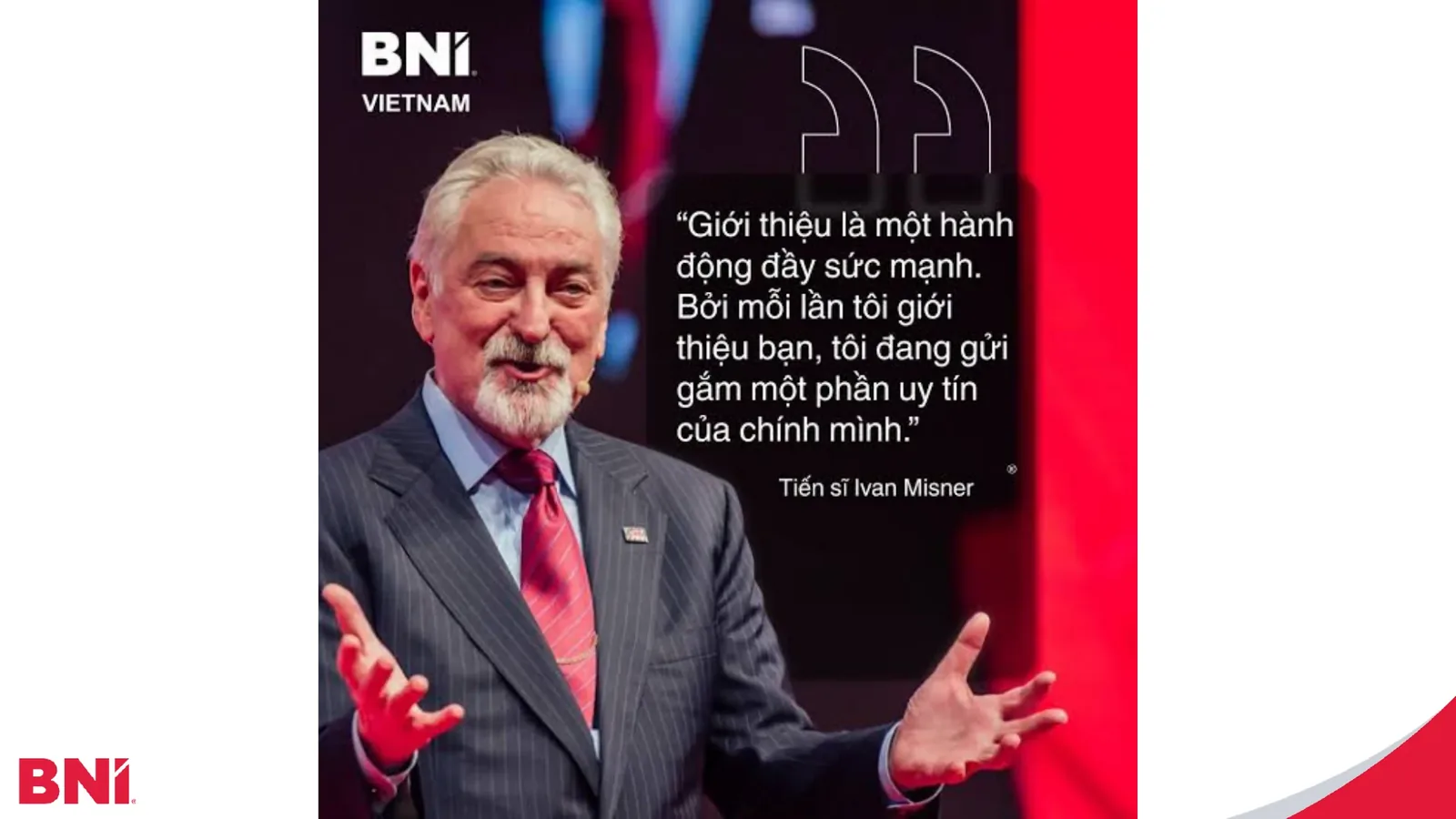
Ethics matters because every referral is the referrer’s reputation handed to the person who receives it. The chapter meeting material quotes Dr. Ivan Misner:
“Referring is a powerful act. Every time I refer you, I am entrusting you with part of my own reputation.”
His article “Five Levels of a Referral” on bni.com makes the same point: the referral giver is, in essence, lending you his or her credibility, which is not something to be taken lightly (Five Levels of a Referral). The article ranks referrals in five levels according to how much the referrer prepares the prospect; with a Level 1 referral you have to do about 95 percent of the work to close.
| Level | What the referrer has done |
|---|---|
| 1 | Given name and contact information; the prospect knows you might contact them. |
| 2 | Added supplementary material: your marketing literature, website or other content. |
| 3 | Shared experience: a personal written testimonial or a strong verbal recommendation. |
| 4 | Made an introductory call and/or arranged a meeting between you. |
| 5 | Made an in-person introduction and joined the meeting to promote you. |
Another article on bni.com separates referrals from leads: leads are generally not expecting your call, while a referral already knows who you are and what you do when you call (The Difference Between Referrals and Leads). It also says never to pass on the contact details of someone who has said they do not want to be connected, which ties directly to point 2 (truthfulness) and point 3 (trust).
Point 4 in practice: following up on referrals
Following up means making contact early, persisting, and reporting back to the referrer. The article “How Referral Follow-Up Maximizes Your Success in BNI” on bni.com explains that the referring member puts their reputation on the line, so an unanswered referral reflects poorly on both sides (Referral Follow-Up). It offers four tips:
- Make it a priority: set aside time each week to review your referrals.
- Be timely: follow up as soon as possible after receiving a referral.
- Stay in touch: if you hear nothing back, follow up again, through several channels if needed (email, phone, text, in person).
- Provide feedback: tell the referrer, ideally in a 1-2-1, whether the referral became business; and don’t forget to give a testimonial as thanks.
At BNI Expert meetings these results are shared openly in the “Referral exchange and quality testimonials” segment. The members’ reporting template has three figures for the week: business opportunities, 1-2-1s held, and an amount with a quality testimonial for the person who helped them.


Professional ethics come first
Point 6 puts each profession’s own standards first: BNI’s official site says BNI requires members to uphold the rules of their professions so as not to violate their ethical obligations (The BNI Experience).
BNI Vietnam’s FAQ is more explicit: where BNI’s general rules could violate a professional ethics code, BNI’s rules are superseded by the profession’s code. The same page says BNI prohibits professionals from acting outside their competence, which goes with point 1: only take on work you can deliver at the quality quoted (BNI Vietnam – FAQ).
When a referral is not handled satisfactorily, the FAQ says BNI has an ethics committee, and the person who gave the referral must report it to the membership committee, who will investigate (BNI Vietnam – FAQ). The Membership Committee also checks references and interviews applicants, so ethical standards are upheld before someone becomes a member.
Point 4 has a supporting tool: the BNI Connect app lets members track referrals and business passed (Exclusive Member Benefits).
| Source | Content |
|---|---|
| BNI Expert chapter | The six “I will…” points of the BNI® Code of Ethics |
| bni.com — The BNI Experience | “BNI requires Members to uphold the rules of their professions” |
| bni.com — About BNI | Accountability: “We keep the promises we make, especially when it is hard to do so.” |
| bni.vn: FAQ | Professional ethics codes take precedence over BNI’s general rules; poorly handled referrals are reported to the Membership Committee |
The six points of the BNI Code of Ethics come down to one idea: do what you promised to your teammates and to the people they refer to you.
Frequently asked questions
How many points are in the BNI Code of Ethics?
Six, each starting with “I will…”: quality at the price quoted, truthfulness, goodwill and trust, following up on referrals, a positive and supportive attitude, and the ethical standards of your profession.
What must a member do after receiving a referral?
Under point 4, the member takes responsibility for following up on the referrals they receive.
What is the difference between a referral and a lead?
According to bni.com, a lead is generally not expecting your call; a referral is someone a friend or associate told about your services who expressed interest, so when you call they already know who you are and what you do.
What happens if a referral is handled poorly?
According to BNI Vietnam’s FAQ, the person who gave the referral must report it to the chapter’s Membership Committee, who will investigate; BNI has an ethics committee.
Sources
- BNI Global — About BNI — www.bni.com/about/, read on 23 November 2026.
- BNI Global — The BNI Experience — www.bni.com/the-bni-experience/, read on 23 November 2026.
- BNI Global — Exclusive Member Benefits — www.bni.com/exclusive-member-benefits/, read on 23 November 2026.
- BNI Vietnam – FAQ (Vietnamese) — bni.vn/vi-VN/faq, read on 23 November 2026.
- BNI Global – How Referral Follow-Up Maximizes Your Success in BNI — www.bni.com/the-latest/blog-news/effective-referral-follow-up-tips-for-bni/, read on 23 November 2026.
- BNI Global – Ivan Misner: Five Levels of a Referral — www.bni.com/the-latest/blog-news/five-levels-of-a-referral/, read on 23 November 2026.
- BNI Global – The Difference Between Referrals and Leads — www.bni.com/the-latest/blog-news/the-difference-between-referrals-and-leads/, read on 23 November 2026.